An F for FACTS
An Analysis of Vladimir Putin’s False Historical Justi of his Invasion into Ukraine
By: Jessie Dromsky-Reed
Vladimir Putin has been thinking about annexing Ukraine long before he invaded on February 24, 2022. Since his presidency began in 2000, Putin has given speeches supporting his belief that the collapse of the Soviet Union was “the greatest geopolitical disaster of the twentieth century,” and outlining his desire to recreate the USSR, of which Ukraine was a major part. Then, most recently in July 2021, he published an article on the Kremlin’s website outlining his interpretation of “the historical unity of Russians and Ukrainians,” which he believes is justification enough for his invasion. The article was officially translated to English and other languages. (The link above to the English translation of the article on the Kremlin’s website may or may not work as due to the current war, the Kremlin’s website—and subsequently the article—intermittently experiences blackouts and becomes inaccessible.)
In the aforementioned article, Putin lays out a chronological analysis of historical facts that he believes proves that Russians and Ukrainians are one people, and therefore he has the right as Russian president to invade, annex, and rule Ukraine. However, Putin’s interpretation of the history and how that history unites the two peoples diverges wildly from historians’ interpretations of those events, often skewing or bending the historical truth to support his violent and unprovoked incursion on the sovereignty of another nation. Russians and Ukrainians share a relationship similar to that of Spaniards and Italians: their languages are very similar and they share a similar history thanks to the Roman Empire conquering much of southern Europe at its height in 117 A.D., but over time, the two groups developed into the distinct cultures and nations with their own sovereignty the world respects today.
Putin’s publication of his misinterpretation of history follows the pattern of tyrants, dictators, and autocrats who have used misinformation to erroneously justify horrid acts of genocide, invasion, and oppression.
As a writer sitting in my home in New Jersey, I find myself wishing I could do more to help the people of Ukraine as they defend their sovereign homeland from this invasion. So, I have decided that the next portion of my article will be dedicated to fighting Putin’s campaign of misinformation. A lofty goal to be sure, but as a Russian Studies major who focused on Russian language and history, I am using my skills and knowledge in the best way I know how. I will present the facts as Putin believes them, and then tell you all what parts are misleading or incorrect interpretations of those facts.
(A note about the quotations: the English language translation of Putin’s article uses the Russian transliterations and spellings of cities and names, but out of respect and as a show of support for the people of Ukraine, I will be using the Ukrainian transliterations and spellings where applicable, ie Kyiv instead of Kiev.)
Putin begins his article very simply at the beginning of recorded Russian/Ukrainian history. He says:
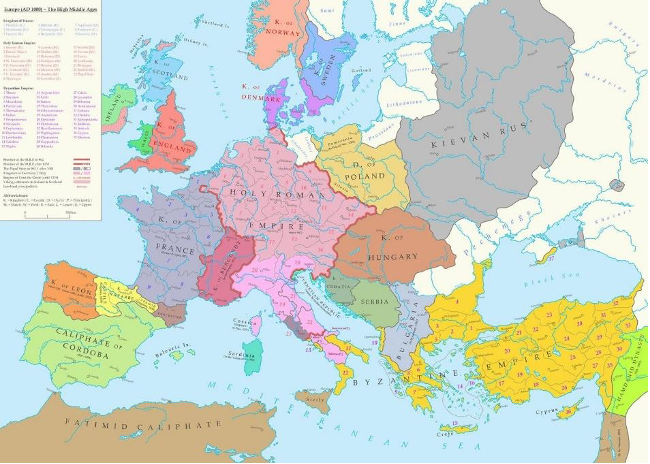
“Russians, Ukrainians, and Belarussians are all descendants of Ancient Rus, which was the largest state in Europe. Slavic and other tribes across the vast territory—from Lagoda, Novgorod, and Pskov to Kyiv and Chernihiv—were bound together by one language (which we now refer to as Old Russian), economic ties, the rule of the princes of the Rurik dynasty and—after the baptism of Rus’—the Orthodox faith. The spiritual choice made by St. Vladimir who was both Prince of Novgorod and Grand Prince of Kyiv, still largely determines our affinity.”
TRUTH: The kingdom of Ancient Rus did exist.
MISLEADING: However, both modern history textbooks and the ancient Eastern European history “textbook” that contains the first written history of modern-day Russia and Ukraine, known as the Primary Chronicle, more often refer to this kingdom as Kyivan Rus’, a name which derives from its largest and most prosperous city Kyiv. Legend has it that Kyiv was founded in 482 C.E., although architectural evidence suggests that the city may have been around much longer. By the eleventh century, Kyiv was one of the largest cities in the medieval world, with a population