To Mr. Chief Justice, and may it please the Court:
I am writing on behalf of the more than 167.5 million women in the United States who now find themselves without access to basic healthcare as a result of the Supreme Court’s decision to overturn Roe v. Wade, 410 U.S. 113 (1973) and declare that access to an abortion is not a constitutionally protected right.
In issuing this Court’s majority opinion on Dobbs v. Jackson Women’s Health Organization, Justice Samuel Alito provides three reasons for this decision: the first being the word “abortion” does not appear in the Constitution; the second being a belief that the right to an abortion is fundamentally different from all other rights protected by the Fourteenth Amendment, and thus, is not protected by the amendment’s “due process” clause; and third being a belief that precedents are meant to be overturned rather than upheld in order to protect Americans from outdated laws and stereotypes.
I disagree with the first two points outright. And while I agree with the sentiment of the third point, I believe it has been egregiously misconstrued to support antiquated, harmful, inequitable, Christian anti-abortion theologies. In this letter, I will speak to each of the Court’s points and present a counter argument in support of the legalization of abortion.
I.)
The Court asserts that because the word “abortion” is not mentioned anywhere in the Constitution, it has the prerogative to determine if the right to an abortion is “deeply rooted in this Nation’s history and tradition” and “implicit in the concept of ordered liberty,” as it had done previously in ruling on Timbs v. Indiana, 586 U.S. ___ (2019) when Justice Ruth
Bader Ginsburg traced the illegality of excessive fines back to the Magna Carta, the English Bill of Rights signed in 1215.
The simple definition of “ordered liberty” is the regulation of freedoms for the purpose of maintaining order in society. According to this Court, the freedom to get a safe abortion does not constitute “ordered liberty” because “until the latter part of the twentieth century, such a right was entirely unknown in American law” (Dobbs v. Jackson 5).
I disagree. Where was the sense of “ordered liberty,” before Roe v. Wade, when women had to navigate the black market looking for abortive procedures and then protect themselves from possible sepsis contracted through nonsterile instruments inserted in the vagina and uterine cavity? Or when women who attempted “safer”, at-home abortion methods, including but not limited to exposure to extreme cold, still ended up dead from their procedure? And where is the “ordered liberty” today, after Dobbs v. Jackson, when women like Madison Underwood have to drive four hours across state lines to receive life-saving abortions? Or when a parentless, sixteen-year-old girl begs the Florida courts for an abortion because she self-identified as “not ready to have a baby,” but the Courts deemed she was too immature to make that decision?
There is no sense of “ordered liberty” in a country where the government prohibits access to life-saving medical procedures and instills a fear of death in half the population by taking away a crucial part of their healthcare. Therefore, I argue that recognizing abortion as a constitutionally protected right and legalizing the procedure would do far more to promote, ensure, and protect “ordered liberty” in the United States than declaring it illegal.
Continually, regarding the omission of the word “abortion” and the subsequent right to it from the Constitution, I ask the Court to consider the Ninth Amendment, which reads: “The enumeration in the Constitution, of certain rights, shall not be construed to deny or disparage others retained by the people.” Or in modern language: the rights expressly written down in the Constitution are not to be used to deny or infringe upon other rights NOT expressly written in the Constitution that the American people feel they possess.
The Ninth Amendment is the Constitution’s way of acknowledging that it is incomplete; the Founding Fathers knew they had not codified every possible right in the Constitution, either that existed in the 1780s, or that would exist in the future, such as the right to interracial marriage or to equal schooling for all children, regardless of race or gender. Alexander Hamilton admitted, in the Federalist Papers, that the Constitution “may not be perfect,” and thus, has procedures embedded in it by which it can change to better protect “the present views of the country” (Federalist No. 85), and most importantly to mitigate “the injury of private rights of particular classes of citizens, by unjust and partial laws” (Federalist No. 78). Pair this with the decision in Taylor v. Louisiana, 419 U.S. 522 (1975), which declares that the time in which women could be disqualified from jury service on the basis that they are inherently unfit “has long since passed…What is a fair cross section at one time or place is not necessarily a fair cross section at another time or a different place,” and the Court is obligated to enact laws that bolster our modern culture and beliefs, not uphold antiquated ideals.
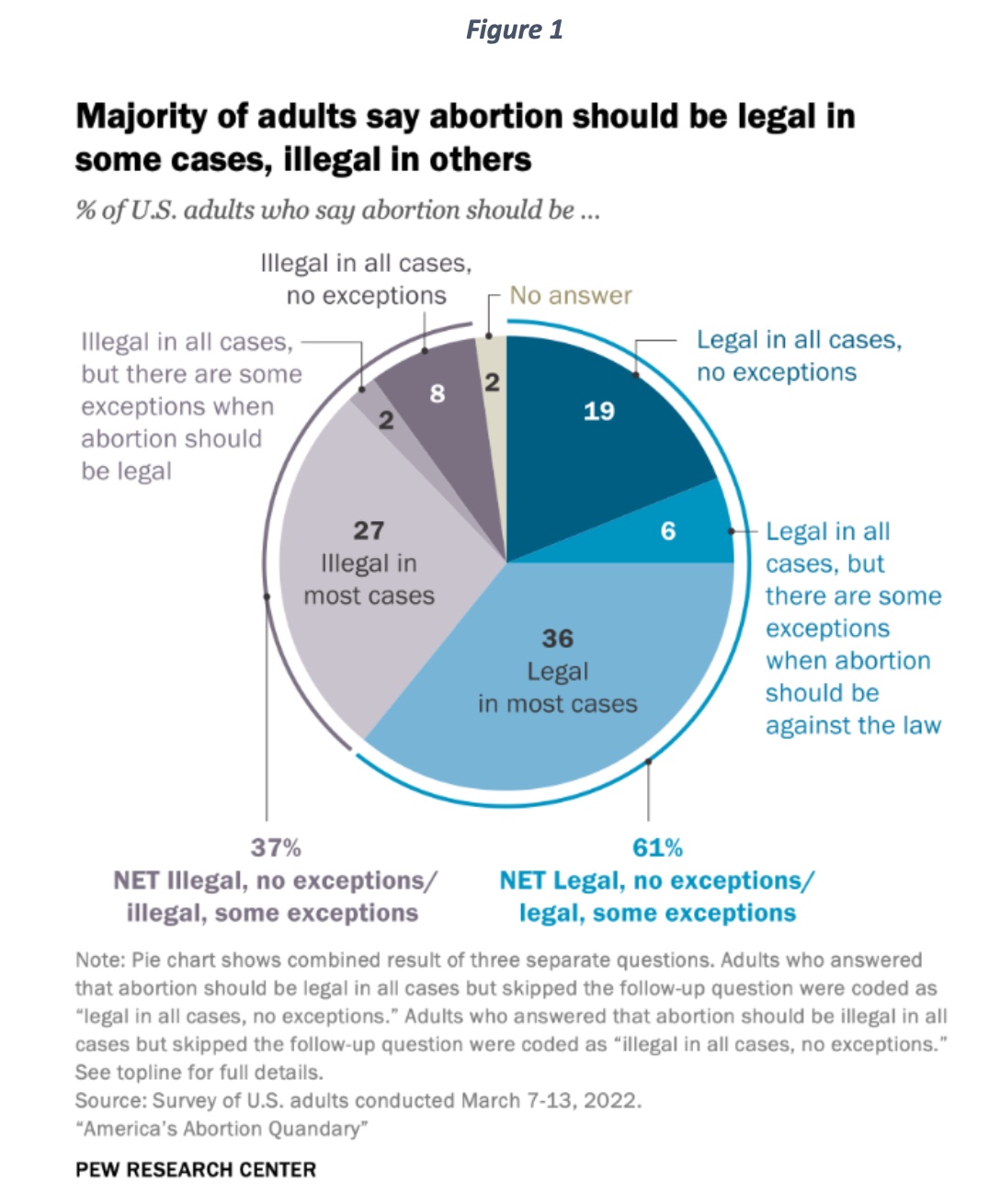
The “present views” of the country are that abortion should be legal in some capacity, as evident in a study conducted by the Pew Research Center (Figure 1).