
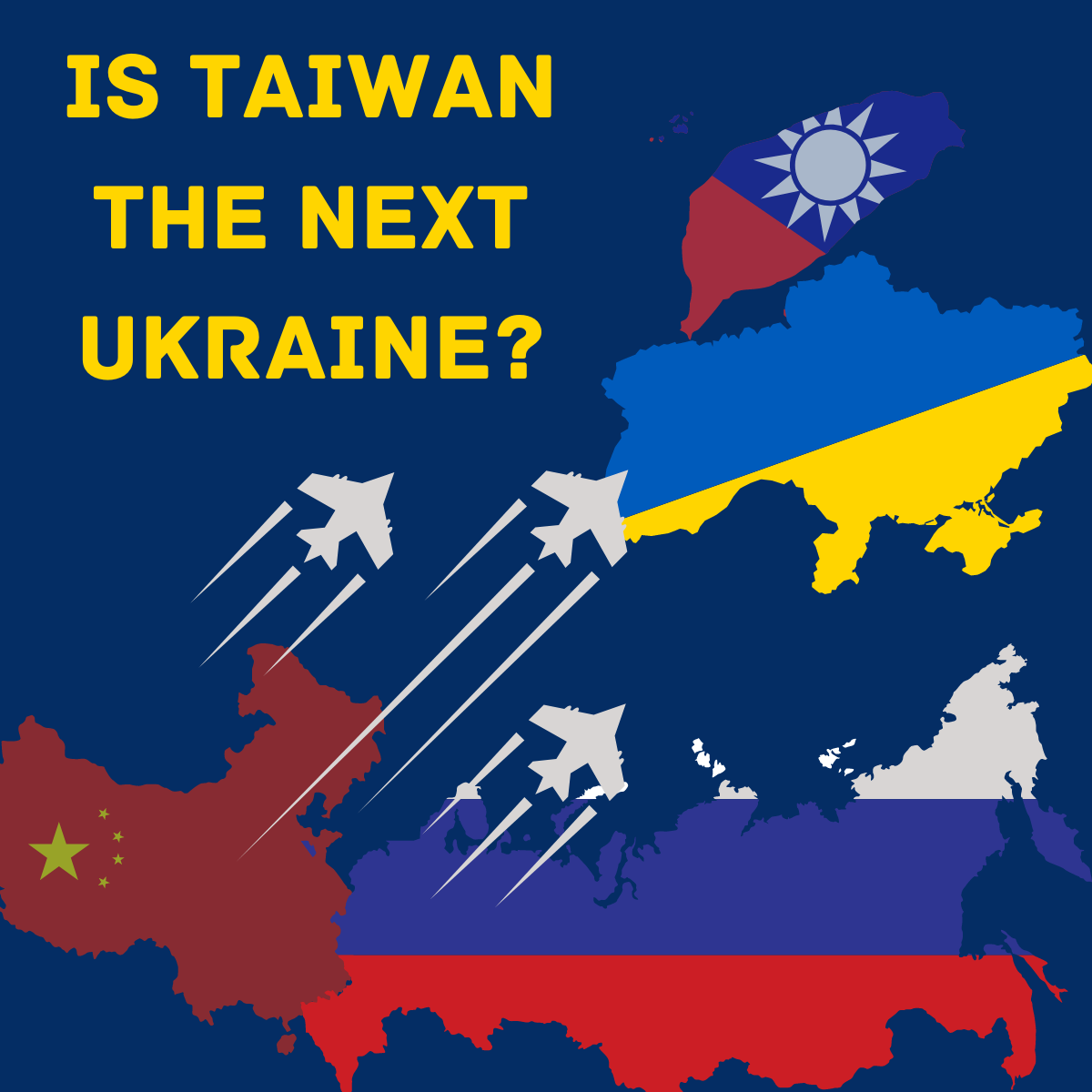
On August 2 and 3, speaker of the US House of Representatives Nancy Pelosi visited Taiwan during a diplomatic trip through Asia. This may seem insignificant—American Congressional leaders visit foreign countries all the time—but Taiwan’s complex and sensitive relationship to China makes this an inflammatory act. Though it has no political or military control, The People’s Republic of China (PRC or mainland China) claims the island of Taiwan, governed by the Republic of China (ROC or Taiwan). A visit to Taiwan from a US official reflects a powerful statement in a tense political landscape—to the PRC, this move acknowledges that the US recognizes Taiwan’s independence from China. Pelosi became the highest ranking US leader to set foot on the island of Taiwan in 25 years, and Chinese leadership reacted furiously, staging unprecedented large-scale military operations around the Taiwan Strait.
These events come at a time of high tension between democratic and authoritarian nations. Since Russia’s full-scale invasion of Ukraine began in February, NATO and western democracies have imposed harsh sanctions on Russia and provided funding to Ukraine’s military. These economic sanctions have severely crippled the Russian economy, though not without repercussions to the countries dealing out the sanctions as well.
China’s relationship with Taiwan resembles Russia’s relationship with Ukraine. Just as Vladimir Putin and the Russian leadership believe Ukraine is their rightful territory, Xi Jinping and the PRC believe Taiwan is its rightful territory and a part of China. For many years, China has taken little action on this belief, but after Russia’s brazen attack on Ukraine, a Chinese invasion of Taiwan seems far more possible. Pelosi choosing to visit now is no coincidence.
A foreign invasion would be nothing new for Taiwan—the history of Taiwan is a history of constant oppression and control by stronger powers. In fact, the current government ruling Taiwan, the Republic of China, took over the island 77 years ago with the help of the United States from its previous foreign ruler, Japan.
Since the 13th century, foreign powers including China, Japan, Spain, and the Dutch East India Company have controlled the island. China first formally annexed the island of Taiwan in the 17th century, under the Qing Dynasty. Before this, Taiwan was populated by an aboriginal population, as well as transient Chinese fishermen and traders. The Dutch East India Company had tried to establish a trading port on Taiwan for nearly 60 years, to limited success. However, by the time the Dutch left for good in 1668, a sizable population of Chinese farmers had permanently settled the island. After the Ming Dynasty fell, the newly established Qing took control of Taiwan in 1683. While they formally controlled the island from 1683 to 1895, their rule was tenuous and faced frequent rebellions. Much of the aboriginal population of Taiwan assimilated to Chinese culture, and those who did not were forced farther west into the mountains.
It was not until 1895, following the Qing’s brutal defeat in the Sino-Japanese War, that China fully lost control of Taiwan. The Qing ceded the island of Taiwan to Japan as part of the Treaty of Shimonoseki. The Imperial Japanese ruled brutally. After two centuries of assimilating to Chinese culture, native Taiwanese now had to bend to Japanese rule alongside their former Han Chinese colonizers. Neither Chinese nor aborigines could hold important government or business positions. Imperial Japan led a campaign against the aborigines who had taken refuge from Qing rule in the mountains, outlawing many native cultural and religious practices. Uprisings and dissidents were brutally suppressed.
After Japan’s defeat in the second World War in 1945, the post-Qing Republic of China took back control of the island. However, the Chinese Civil War between Mao’s insurgent CCP and the ruling ROC resumed almost immediately after the Japanese threat to China faded. Mao’s forces won decisively in the mainland, capturing Beijing and establishing the People’s Republic of China in 1949. Chiang Kai-Shek’s ROC forces retreated to the island of Taiwan, some of the last territory they controlled. By 1961, the PRC had fully captured all of China outside of Taiwan.
The last time the PRC and the ROC engaged in major fighting was 1958, and since then, an uneasy peace has settled between the two governments, reinforced by the 1992 Consensus. This ambiguous agreement emerged from a poorly documented meeting between ROC and PRC officials in Hong Kong in 1992. Both governments claimed to have reached a consensus, but their interpretations vary. PRC leaders insist that they agreed on the idea of “one China” in which the PRC’s Beijing government would be recognized as the only legitimate Chinese government. Taiwanese leaders such as Tsai, however, have rejected this interpretation of the 1992 meeting. There is no official record of what happened.
Both the PRC and the ROC claim full sovereignty over all Chinese territory—the PRC claims to control Taiwan, and the ROC even claims to control mainland China. For Americans, this would somewhat resemble an alternate history in which the Confederate leaders and army fled to Puerto Rico after losing in the American Civil War, where they ruled the island as the Confederate States of America, yet claimed to govern the continental United States, which in turn claimed to govern the Confederacy in Puerto Rico.
The influence of Japanese rule, the aboriginal population, and the harsh effects of the Cultural Revolution and communist policies on the mainland have made modern Taiwan a unique country with its own sovereignty and identity. While the Chinese Communist Party has radically changed Chinese language, culture, and social structure since the 1950s, Taiwan has come to stand both as a bastion of preserving traditional Chinese cultural elements and as a pro-western, democratic, capitalist nation. Anti-communists, intellectuals, former ROC government officials, and many other groups in danger of persecution by the CCP fled to Taiwan before and during the Cultural Revolution era.
In 2016, the election of ROC president Tsai Ing-wen (蔡英文) reignited tensions between the two governments. President Tsai took a firm stance against the 1992 consensus and China’s yiguo liangzhi (一国两制 or One Country, Two Systems) principle. Yiguo liangzhi guided China’s relationship and reacquisition of Hong Kong and other Tebie Xingzhengqu (特别行政区 or Special Administrative Regions). It asserts that these regions of China, while maintaining some cultural and governmental independence from the PRC (two systems), still recognizes itself as part of China and not an independent nation (one country). When Donald Trump became president of the US in 2017, he further stirred the tension by having a phone conversation with her, which the PRC interpreted as an acknowledgment of Taiwan’s sovereignty.
Along with all but 13 small nations, the United States does not officially recognize Taiwan as a country. Outside of informal relations such as Trump’s phone call or Pelosi’s visit, the US does not maintain official diplomatic ties with the ROC. However, President Biden did indicate that the US would respond militarily to a Chinese invasion of Taiwan. While economic sanctions have proven quite effective in slowing Russian success in Ukraine, Western powers may be far more hesitant to enact the same measures on the “world’s factory” and second-largest economy as the relatively small, natural gas-dependent economy of Russia. Sanctions against Russia caused an economic dip and increased heating and gas prices in winter. Sanctions against China could mean global recession.
The question remains, then: will the PRC follow Russia’s lead and use military force to conquer Taiwan, their Ukraine?
Their military may well be up to the task. China has leveraged its burgeoning economic power to build up a formidable military and navy. China’s military spending, while still less than half of the United States’, is the second highest in the world and nearly 5 times that of Russia. The PRC’s navy could reasonably launch a far more effective offense against Taiwan than Russia did against Ukraine.
However, a major factor that makes a full-scale invasion of Taiwan far more difficult than Russia’s invasion of Ukraine is the geographical relationship between Taiwan and China. While Ukraine shares a long, flat land border with Russia, Taiwan is separated from mainland China by the Taiwan Strait, 80 miles wide at its narrowest. This stretch of ocean is what allowed the ROC to maintain Taiwan even as the PRC captured all of its former territory after 1949. Even as 21st century innovations make long-distance military technology such as drones, missiles, jets, and submarines far more effective than the technology used in previous attempts at land invasions, the fact remains that only ground forces can establish control over a land area. The PRC’s military exercises on August 3 were meant to show their ability to “militarily blockade” Taiwan with at least 68 warplanes and 13 warships, according to the ROC’s Ministry of National Defense. Not the ability to conquer by land.
Even if Chinese forces did successfully land on Taiwan, seizing control over well-defended cities and a resistant population would present an even greater challenge. Other global superpowers, such as the United States in Vietnam and Russia in Ukraine, have already learned or are now learning harsh lessons about how difficult a land invasion of a country with a population and military that will stand up to bullying. In fact, in its last major conflict, the 1979 Sino-Vietnamese War, China’s People’s Liberation Army (PLA) also experienced mixed success in their own invasion of Vietnam. Though the PRC claimed victory in this war, they retreated from Vietnam without accomplishing their stated goal, which was to intimidate Vietnam out of opposing Pol Pot’s leadership in neighboring Cambodia.
Despite a far greater economic independence, resistance to potential foreign sanctions, and military technology than Russia, China’s prospects of military success in Taiwan remain uncertain at best, dismal at worst. Even with the unprecedented show of force in early August, the PRC faces a monumental military and political challenge by escalating conflict with Taiwan. While China’s economic influence grows steadily, its military likely cannot conquer an island nation whom the United States has pledged military support to defend. Yet, like Russia, they can try, and such an attempt could have disastrous economic costs and a toll on human life.


